
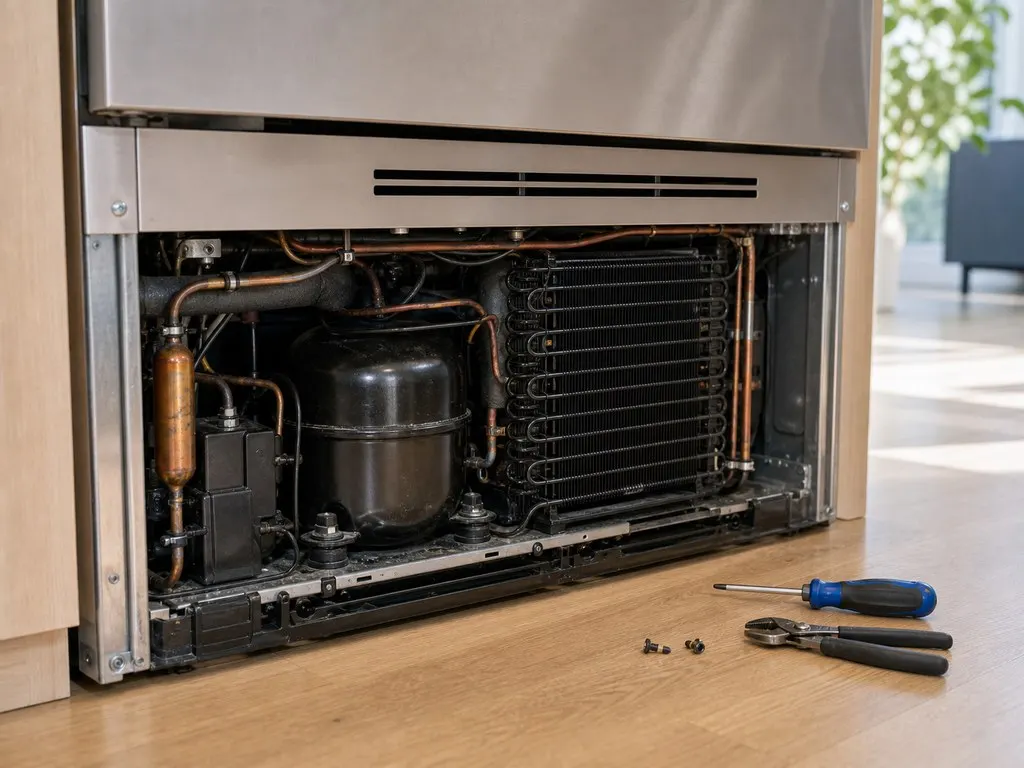
A noise map for a built-in Sub-Zero
Sound is the most useful clue a refrigerator gives you, because each part fails with its own voice. A built-in Sub-Zero has two fans, a compressor on rubber mounts, a water valve, and a defrost system — and a new noise from any of them carries a different meaning. Before we touch a panel, we listen: where the sound is loudest, whether it rises and falls with the cooling cycle, and whether it changes when the door opens. That alone narrows the repair to one or two parts.
| Noise | Likely source | What it points to |
|---|---|---|
| Steady hum or buzz | Evaporator or condenser fan | Worn fan motor or bearing |
| Tick, scrape or chirp | Fan blade catching ice | Frost on the coil; defrost check |
| Low rumble or vibration | Compressor and its mounts | Aged mounts, compressor under load |
| Bang or knock on fill | Water inlet valve (hammer) | Valve or supply pressure |
| Gurgle or trickle | Refrigerant or normal flow | Usually normal operation |
A new or changing sound matters more than a familiar one — we diagnose the change, not the baseline hum.
If the unit is also warming, a stalled fan is doing two jobs at once — see not cooling. A tick that comes with a frost wall ties back to the defrost circuit.
Normal sounds versus a service call
Not every sound is a fault. Sub-Zero built-ins are quiet by design, but they are not silent, and the open-plan kitchens common in Sunnyvale make a faint hum carry further than it would in a closed galley.
- Normal: a soft fan hum, an occasional gurgle as refrigerant moves, a quiet click as the compressor or defrost cycles on and off.
- Worth a look: a buzz or rattle that has grown louder, a grinding or squealing fan, a fan that ticks against ice.
- Book promptly: a loud knock on every ice-maker fill, a vibration you can feel through the cabinet, or any new noise paired with warming.
Noise repair pricing in Sunnyvale
| Repair | Draft range | Time |
|---|---|---|
| Diagnostic / service visit | $89 | 45–90 min |
| Evaporator / condenser fan motor | $280–$650 | 1–2 h |
| Fan icing (thaw + defrost check) | $280–$650 | 1–3 h |
| Water inlet valve (hammer) | $200–$460 | 1–2 h |
| Compressor mounts / sealed system | $1,450–$3,600 | 2–6 h + parts |
Draft ranges for planning only; a deep compressor noise is confirmed with evidence before any quote.
A fan is a modest repair; a genuine compressor noise is the rare, larger one, and we confirm it with pressure and electrical evidence before quoting — never from sound alone. The $89 visit is waived when you book, with a 365-day labor warranty. See repair pricing.
How to place a Sub-Zero noise before the visit
You do not need to fix the noise — just help us place it. A minute of listening and a couple of quick checks often points straight to the part.
- 1 Locate where it is loudest
Stand to the side, then near the toe-kick grille, then near the top. A sound loudest low and at the back usually means the condenser fan or compressor; loudest inside usually means the evaporator fan.
- 2 Note when it happens
Does it run constantly, rise with the cooling cycle, or only bang when the ice maker fills? Timing separates a fan from a water-valve hammer almost every time.
- 3 Check the grille and leveling
Make sure the toe-kick grille is seated and the unit is level and not touching the cabinet. A loose grille or a unit leaning on a panel can buzz like a failing part.
- 4 Listen for ice contact
A rhythmic tick or scrape can be a fan blade clipping frost. If you also see a frost wall, mention it so we check the defrost side on the same visit.
- 5 Power-cycle once
Switch the unit off and on once. If the noise returns, record a short phone video of the sound — it genuinely helps the technician arrive with the right OEM part.